Thursday, 10 May 2012

3D Monitors For Your Gaming Rig

3d games and movies are becoming increasingly common these days and to really enjoy this 3d content, you’ll need a number of things, Firstly and a 3D capable PC, since 3d processing does take a little more power than your everyday gaming PC. Once you have that figured, you have the games, and, of course, you’ll need a good 3d display. To be Honest, there aren’t too many great 3d displays available, but we’ve scoured the market to find five that we think you might want to consider. 

BENQ XL2420T

Benq is one of the newest entrants into the display market, but they've been around for a years now, launching mainstream displays as well as displays for professionals and gamers. Their new XL2420T is a stylish, 24-inch full HD 3D display.The XL2420T is a high-performance gaming monitor suited for FPS game play. Co-designed with Counter-Strike legends, the 120Hz, 24”W, 3D-ready LED monitor gives gamers a competitive edge with features like the Black eQualizer, S Switch, FPS Mode,Display Mode, Smart Scaling, 2ms GTG, and 12M:1 DCR


LG D2342P
LG has been one of the pioneers in the field of 3D displays. Last year, they launched their cinema 3d FPR technology , which used passive 3D glasses instead of active ones. the advantage was that they were lighter , more compact and most importantly, they did not give the user a headache after brief usage. There's no need to even charge the batteries or sync the glasses with the display. Viewing angles are also are better and LG bundles two glasses - one that is conventional and the other of the clip-on variety, meant for those who use spectacles. The same technology has come to the 23-inch D2342P LED-backlight LCD monitor. In terms of connectivity, there's a DVI, D-Sub and HDMI port. There's also the 3.5mm analog out put. With an attractive price tag, the D2342 makes for a very good purchase, indeed.


VIEWSONIC V3D245

Viewsonic has been around a while, and when it comes to displays, they're known for some really great quality panels. ViewSonic’s 24" (23.6" viewable) V3D245 3D LED display features a fast 120Hz frame rate and Full HD 1080p resolution. It supports HDMI 1.4 and stereo 3D technology so users can enjoy stunning stereoscopic visuals using active shutter glasses. With exclusive ClearMotiv™ II imaging technology images are crisp without blur. Smart Dynamic Contrast Ratio technology automatically detects screen content and adjusts the backlight brightness, creating deeper black levels and effectively minimizing external light interference. In addition, integrated speakers powered by SRS Premium Sound® produces incredible audio effects, making the V3D245 more than just an LED display, but the ultimate audiovisual entertainment system.


ASUS VG236HE

The Asus VG236H is a 23-inch, full HD 3D display, which is branded as an Nvidia 3D vision supported model. The monitor's features are similar are similar to the rest of the models we've been talking about, i.e. it has  DVI and HDMI ports, but also component connectors, which means you can connect set top boxes and consoles if you'd like. There's also some flexibility as far as the display's stand goes. Users can raise the stand up to the desired height and the displays can also be swiveled accordingly.Asus give users  an immersive 3-dimensional Full HD 1080p world of games and movies throught the VG236HE. Through the use of market-leading 3D technology and active shutter glasses, it instantly takes you into another dimension—transforming your gaming experience to 3D.


AOC E2352PHZ
Aoc has crept into the LCD display with some real good pricing on its products, It's been the underdog, so to speak, over the past few years. The E2352PHZ may not much to look at, but it's an affordable option for those who looking for a 3D capable monitor. There are speakers buit into the display which means you don't have to absolutely depend on headphones or external speakers.There's is also a 2D-to-3D content that convert  suddenly lets you much more content in 3D.AOC brings 3D to your PC, e2352Phz features Flicker Free 3D technology, passive polarized glasses continuously show a different image pattern to each eye, without the on-off switching typical of many 3D displays, so you enjoy pleasant, vivid 3D images with a wide viewing angle. Ultra-high dynamic contrast of 20,000,000:1 reveals more depth and detail in darker scenes. Built-in speaker for improved desktop sound. e2352Phz connects to any PC, and its HDMI 1.4a input is ready to play 3D video and sound from the latest consumer electronics devices, including 3D Blu-ray and game consoles. The LED backlight panel saves the environment, containing no toxic mercury and using only half the power of traditional CCFL screens. To enhance your total viewing pleasure, the monitor design is slim and streamlined, with discreetly concealed control buttons. 

Tuesday, 8 May 2012

E-Learning: Benefit from Virtual Universities

No more worrying about missing lectures because of work or not being able to complete a course! Thanks to e-learning, you can now log in to your lectures from virtually anywhere in the world.


There is no denying the fact that having an additional degree can improve your career prospects. But once you start working, pursuing a professional course along with work can prove to be challenging. This is true even if you opt for distance learning or part-time courses. Distance learning involves mostly self-study, at times coupled with a few lectures before the exam. If you are a working professional, self-study mostly goes out of the window. Most of us end up not studying if there are no lectures that we need to attend. And even if you do, more often than not, you end up mugging up things without really understanding the subject. When it comes to part-time courses, you may not find time to attend classes. If you have faced a similar dilemma, then take heart, as you now have the option of opting for e-learning. While learning foreign languages online has been popular for few years, you can also opt for more traditional classroom courses like MBA, BBA, MCA, BCA, etc. through e-learning. Many Indian universities have collaborated with online platforms to develop content and offer e-learning courses.


Why E-Learning?
E-learning has opened up avenues not only for working professionals, but even for those who are deprived of good universities in their home towns. You can choose amongst the finest of universities and opt for e-learning no matter which part of the country or world you reside in. All you need is a decent Internet access.
                                      Speaking about the draw of e-learning, Raunak Singh Ahluwalia, Director, University18, which is an online education platform for universities like Don Bosco University and Karnataka State Open University, amongst others, says, “While cultures, business, technology and lives are becoming increasingly global, traditional distance education has stagnated to a large extent. Most distance learning or continuing education programs are limited to a geography – that of a ‘study center’. In the two years of our existence, we’ve seen over three thousand individuals enroll at a 100% year-on-year growth rate. We’ve also been surprised with the kind of interest corporations and companies have shown in these programs, with several coming forward to sponsor their employees.” So what is it that gives e-learning an edge over distance learning? There are several factors that have fueled its growth; convenience and flexibility being the foremost amongst them. Right from selecting the university of your choice to determining the study pattern, to flexible examination pattern and easy installments for fees payment, these online education portals score over traditional distance education options. Furthermore, Raunak points out the other important factors that work in favor of e-learning. “Online programs at U18 attract students from every corner of the world. You may just end up attending class with a global peer group, with the other students logging in from the United States, Africa, the Middle East or Australia. This adds to the diversity, hence contributes to the peer learning process and classroom discussion. Besides this, we can and do draw our faculty from just about anywhere. A typical Program has a professor from about eight different B Schools in six-eight different cities.” e-Learning Process While there are different forms of imparting online education, do not get swayed by courses that claim to offer e-learning, but only offer study material online. An e-learning program is a blend of online virtual classrooms, reading material, both online as well as offline, online support and online examinations. In a typical e-learning program, the courses are conducted via virtual classrooms, with students and teachers logging in to a session at a pre-determined time. The students and teachers can then interact over chat as the class is in progress. So the basic teaching principles are simply replicated in the virtual world and one can quickly adapt to it. Additional there are notes, presentations, etc. that you can refer to side by side, and you also have the option to download a particular lecture in case you have missed it. You can get the entire recording of the day’s session, which you can then watch as per your convenience. For instance, if in middle of traditional part-time or distance education program, you are required to travel for work to another state or country, then you would not only miss out on the sessions for those many days, but worse still, you may have to abandon the course halfway. In case of e-learning that wouldn’t pose a problem, as you can still log-in to your sessions from virtually anywhere and you also have the option to download them for later viewing. Apart from this, there are also additional tests that you can take from time to time to determine your own progress as well as forums to clear your doubts. When it comes to the content, special emphasis is given to make it relevant to a larger audience and to make sure that it is up to date. Raunak explains, “While designing online courses in continuing education, it becomes important to ensure that the content and material is designed in a manner that is suitable for a wider variety of students. A classroom course at a University program can predict with fair accuracy the average age (18-20), IQ (100?), and experience (none) its candidates have. In online programs, age and the number of years of experience, and hence, experiential
knowledge are key factors, given the fact that these are mostly part of ‘continuing education’ for candidates. We, for instance, see students in the age group of 30 40-50 in a larger number than those in 18-20. Hence, the content is designed carefully, so that it is both relevant and  understandable to such a wide audience.” Most of these courses are aimed at working professionals and therefore focus on the knowledge and skills that are currently in demand. In keeping with the current trends, Raunak says that they plan to introduce new courses in 2012, “The key focus areas are entrepreneurship, business and technology in the new economy. The year 2012 will see the launch of a large number of Diplomas and Certificate programs, specifically targeted towards certified employability. For instance, the Don Bosco University Diploma Program in Web Design, a 12-month program covering fundamentals of software engineering, UI design, as well as programming and development on PHP/LAMP, is targeted at the nation’s skilled programming workforce, who may not have graduated, but sure can code. These programs will give their coding skills a structured design and develop skills that give them an edge.” 


Who should opt for e-learning?
              E-learning is a boon for working professionals, those who cannot travel due to some handicap, or those in towns that do not have good educational institutes. However, there are certain things one should keep in mind before opting for online e-learning programs. Raunak says, “Online education is the way of the future, and in my opinion, a very important trend in the development of the way we study and learn. While online programs are a smart choice for continuing education, students should understand that these programs require discipline, a fair amount of Web skills, and access to a good Internet connection. Unlike in a 'study center' or college, though it would be common to see peer groups forming online), and would need to ensure he/she is disciplined enough to follow through with the program. If you're looking at enrolling in an online course because you assume that it'll be easier to pass, or is cheaper than the distance learning programs on offer from that Institute, or is of a shorter duration, then you should reconsider your motives.”

Sunday, 6 May 2012

E-waste: Rethink, Reuse, Recycle


While tinkering with your new gadget, take some time to think about what you will do with the one it's replaced. Ensure that it doesn’t end up in the mountain of e-waste, which is growing at an alarming rate.


Technology is ever changing. Every day new products are being launched that are being lapped up by millions around the world. But what happens to the gadgets that get outdated and replaced by new ones? Abandoned electronics and other e-waste are being carelessly dumped, causing landfills. This not only adversely impacts the environment, but it also creates health hazards. A report published by the United Nations Environment Programme and United Nations University estimates a 500 percent growth in e-waste over the next 10 years in India alone, with mobile phones being a significant component. According to the report, the United States is the biggest producer of e-waste, generating around 3 million metric tons a year, closely followed by China, which produces around 2.3 million metric tons. Apart from the rising local e-waste, countries like China, India and South Africa also have to deal with e-waste that is dumped from around the world, and this calls for stringent measures in handling e-waste as it not only impacts the environment, but also has several health hazards. It contains toxic substances such as lead, phosphor, mercury, cadmium, gallium arsenide,etc. that are injurious to health. Out of these, lead is particularly hazardous and prolonged exposure can affect the nervous system.

E-waste Recycling

E-waste is being carelessly dumped in the open. Typically, you will fi nd rag pickers rummaging through the piles of e-waste and using strong acids to retrieve precious metals such as gold, etc. They do so without wearing gloves or masks, thus exposing themselves to health hazards. This also holds true for the booming
illegal informal e-waste recycling plants that have mushroomed everywhere. The workers work in poor conditions with absolute disregard for their own safety and after the precious metals have been recovered
from the scrap, the rest is carelessly dumped. Rohan Gupta, COO, Attero Recycling, points out the implications of such unchecked activities, “Most scrap dealers resort to crude and highly unsafe methods for recycling of e-waste, resulting in severe environmental and health hazards. Some of the processes involve soaking of circuit boards in acid, followed by manual scrapping to extract metals, with the residue thrown into open drains. Such unchecked activities without proper protection to workers are hazardous not only to labor involved, but also to the environment. Organized recycling of this hazardous waste is the only answer to the problem. Hopefully, with corporate governance and corporate social responsibility gaining momentum, various public and private sector units will start partnering with integrated e-waste solutions providers to manage their e-waste.” Attero Recycling runs India’s fi rst and only end-to-end, integrated e-waste recycling plant that deals with all kinds of e-waste that includes a range of obsolete electronic devices or end-of-life electrical and electronic devices. They collect e-waste, transport it to their processing plant in Roorkee, extend the life of usable components and recycle all other e-waste and sell the pure metals for reuse. Gupta
says, “We have the unique capability to extract pure metals from e-waste, which is available with a few companies worldwide, and we are proud to say that the state of art technology has been developed indigenously by us. We remove hazardous substances and then dispose of the hazardous waste in a government-approved TSDF. The pure metals produced, like copper, iron, aluminum, etc. are put back into the market. We also have the strictest environmental practices in place. We undergo regular environmental audits and are ISO 14001 and OHSAS 18001 certifi ed. We have ensured that we undergo audits by international organizations so as to set international benchmarks. This ensures that our recycling uses one of the cleanest processes.” Gupta laments the lack of awareness amongst the people with regards to e-waste. “People still feel that used electronics are not hazardous and it would fetch them good money. It is important that we start realizing that electronic goods contain lots of hazardous material and they should be recycled in a controlled environment. If not recycled properly, the e-waste would wreak havoc with our environment right from polluting our water with heavy metals like mercury, lead, etc, to releasing carcinogenic air pollutants.
                  E-waste should never be disposed off with solid and other household wastes and should not be given to scrap dealers or unauthorized recyclers. It should be segregated at the site and the e-waste should be given to only Central Pollution Controlled Board-authorized recyclers like Attero. There are also many environmentally responsible companies, who take back their used products for recycling, and such channels should be used by everyone to dispose off their e-junk.”


Mobile phones contain toxic materials like lead, zinc, and arsenic, apart from precious metals like gold, silver,
palladium, etc. When the phones are dumped in a landfill, these materials percolate and pollute the soil and ground
water, and with the ever increasing number of mobile phones, this poses a great threat.


What can you do?

Though e-waste is a huge problem, it begins with each one of us. So think twice before discarding your old PC or mobile phone. There are many uses for your PC. For starters, if your PC or laptop is in a reasonably good condition, you can always give it to those in need. You can even donate it to local municipal schools or NGOs. Alternatively, you can also use the hard drive form your old PC as a server to back up your data. If peripherals like keyboard, mouse, speakers, printers, scanners, etc. are in fairly good condition, you can sell them on eBay. You can sell your old mobile phone, MP3 player, DVD player, digital camera, TV, etc. online or give them away. Leading brands like HCL, HP, Nokia, Samsung, Sony Ericsson, Wipro, Dell and IBM have taken up recycling initiatives. You can contact them or drop off your computers/handsets at their authorized collection centers from where they will be transported to be recycled. For instance, you can walk into any Nokia Gallery and drop off your Nokia mobile, charger or even battery in the dedicated collection box, and rest assured that it will be taken care off . To encourage people to opt for recycling, many of these brands also off er discounts on their next purchase.

please note that : This Article is prepared under the base of Indian conditions 


Wednesday, 2 May 2012

Sony VAIO T11 and T13 ultrabooks official


Sony has officially revealed its first ultrabooks, the Sony VAIO T11 and T13, with a choice of 11.6- or 13.3-inch displays, slick magnesium and aluminum chassis, and optional SSD storage. Promising up to nine hours battery life from the SSD models, the new T11 and T13 VAIOs include full-sized VGA, HDMI and ethernet ports, along with memory card readers and both USB 3.0 and USB 2.0 ports.


There’s also Bluetooth 4.0+HS and WiFi b/g/n, though Sony hasn’t said whether it will be offering a WWAN option with integrated 3G/4G. Processors are plucked from Intel’s 2nd Gen Sandy Bridge range, kicking off with the Core i3-2367M with Intel HD 3000 graphics; they’re paired with 4GB of RAM and either HDD, HDD/SSD hybrid, or full SSD storage.


Runtimes for the HDD and hybrid models hasn’t been revealed, but the power-efficient SSD models should last for up to nine hours. Meanwhile, standby power consumption has been dramatically slashed, with Sony claiming the new ultrabooks can sit in sleep mode for up to ninety days without running out of charge.


Sony Vaio Specifications


Sony’s inimitable style comes into play too, with the VAIO T11 and T13 looking suitably distinctive with their squared-off edges and buttonless trackpad. The 13-incher comes in at 226 x 17.8 x 323 mm and 1.6kg with a 1366 x 768 display.


No word on pricing yet, but the VAIO T11 and T13 will go on sale later this month.


Source

Monday, 30 April 2012

BlackBerry Torch 9810


BlackBerry Torch 9810a good piece of mobile hardware and quite worth the price.


For: Well designed, fluid UI, solid build quality.


Against: Still a little bulky, battery life could have been better.


Nearly a year after the original Torch arrived in the market, RIM has revealed the Torch 2 - or 9810. From a design and form-factor point of view, the 9810 is exactly like its predecessor and the build is just as solid. The slide out QWERTY keypad is just as smooth, but the keypad could have been slightly more spread out to optimize typing. The only thing that may give the phone away would be its new color scheme: shiny silver instead of the gunmetal grey finish. It’s still just a little on the heavy side at 161g and the rubberized sides do allow you to get a good grip on it.

The Torch 9810 is equipped with a 5.0 megapixel
camera with autofocus and LED flash.
                               As usual, the bundled handsfree and cables are as good as they come. The inclusion of a smart case would have been brilliant, or a memory card for that matter, but considering the internal storage has been beefed up to 8 GB, the latter point is quite moot. It was never too hard on the eyes and the new jazzed up color combo adds a bit of elegance to the overall appearance. The 3.2-inch screen gets a decent bump in resolution, and it now runs at 480 x 640 pixels. While the exteriors might be the same, there are a few very good changes on the inside, most important among them being the processor. With the inclusion of a 1.2GHz CPU, the 9810 can now play toe-to-toe with the fastest smartphones in the market. This change, along with OS 7.0, makes for a superb browsing and in-app experience. The phone responds and moves from task to task effortlessly and screen renders are instantaneous. Browsing especially gets a shot in the arm, and we think even the fastest Android phones may struggle to keep up. Media capabilities are still quite up there with the best, though the lack of 1080p video playback might be considered a drawback. It supports XviD and DivX codecs and plays most file formats except FLV and MKV. Music playback, thanks to the audio engine’s Audio Boost and EQ presets, worked as well as RIM’s other offerings and the bundled handsfree proves well-matched to the output quality for calls and music. Although this device is equipped with a GPS module, you’ll still have to contend with BlackBerry Maps showing you in the middle of an empty screen for Indian residents. The other option is Google Maps or paying for third party software. The 5 megapixel auto focus camera (with LED flash) also remains unchanged. It features settings like image stabilization and geo tagging, face-detection, as well as continuous auto focus while recording video at 720p. Image quality is just as good as the 9800’s. Seeing as smartphones, and especially BlackBerrys, are the type of handsets that one would tend to use on a frequent basis, the Torch 9810’s battery proved to be average. It’s expected that a device of this caliber would offer a little more than just keeping in tow with the rest.

NVIDIA announces their top card in the stack – the GeForce GTX 690

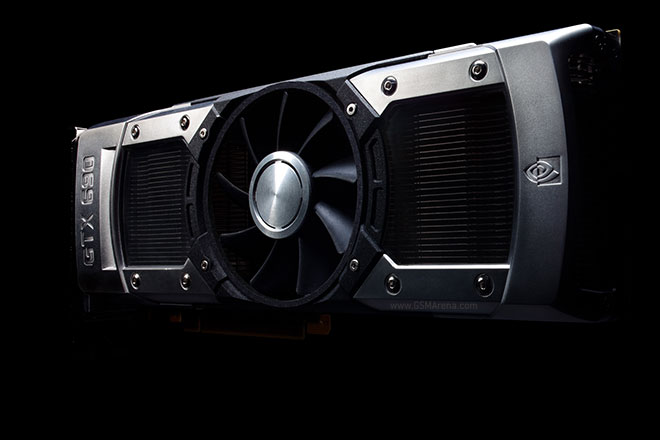
Nvidia announced its newest flagship graphics card at the NVIDIA Gaming Festival 2012 in Shanghai, the GeForce GTX 690. Combining two GTX 680s on a single card, the 690 is going to be one hell of a performer.


Combining two chips on a board is always tricky business and contrary to what one might expect the performance is not exactly double that of a single GPU card. In fact it’s usually less than the two cards running in SLi mode. But with the GTX 690, NVIDIA is aiming to get performance that will be equivalent to running two GTX 680 in SLi, while maintaining the convenience and lower cost of having a single card in your system.


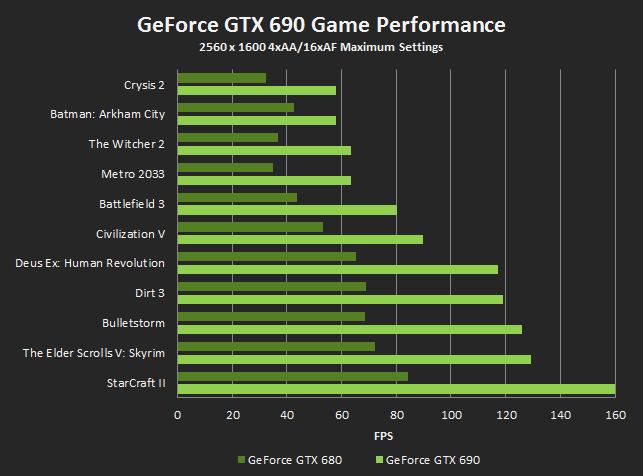
Unfortunately, we don’t have any reviews out yet for this card but if NVIDIA’s own scores are to be believed, the GTX 690 is on an average 75% faster than the GTX 680 in the same games.

But performance is not the only thing NVIDIA was after with the GTX 690. For the first time, a considerable amount of time and effort was also spent in improving the industrial design of the GPU. The design and the materials used take great inspiration from the engines of supercars and the outer shell in particular is made to look like an F1 car’s engine block.

But of course, looks aren’t everything and the design also has to be good at dissipating heat, especially on a dual-GPU card. For this, the 690 uses a pair of custom vapor chamber heat sinks cooled by a center mounted axial fan which should help keep the temperatures and sound levels down.

The GTX 690 will go on sale on May 3. Priced at $999, the GTX 690 costs exactly twice as much as the GTX 680 and is NVIDIA’s most expensive graphics card yet. Considering that the performance is roughly equivalent to dual GTX 680 in SLi, the pricing is appropriate. What little you lose in terms of performance you gain in terms of reduced power consumption and the convenience of having just one card inside your PC. We will still have to wait and see how well it performs in the reviews when they eventually come out later this week.

Motorola Xoom 3G


 Motorola Xoom 3G - Currently, the cheapest 3G tablet with 32 GB storage in the market.


For: Good value, Honeycomb 3.1, dual core, HDMI, Good camera.


Against: Average battery life, no customization for Motorola’s end, not
very slim .


Motorola’s Xoom was the first commercially available tablet to rock Google’s Honeycomb OS. The Xoom comes with Android 3.1, which is lot faster and smoother than the 3.0. An aluminium frame makes up most of the body which is smooth and does not attract finger prints. The 10.1-inch screen sports a 1280x800 pixel resolution and the Xoom is powered by Nvidia’s Tegra 2 CPU which runs at 1 GHz. The internal memory is 32 GB and is the same for both, the Wi-Fi and 3G models. The video player only supports MP4 and WMV file formats along with codecs like H.264 and H.263. 1080p videos play just fine provided they are in MP4 format. The music player is very basic too, with no equalizer presets or enhancement options. The supported file formats include MP3, WAV, WMA and AAC+. Sound quality is once again just average so if you’re serious about music, look elsewhere. 
                               
                                           The 3G version supports quad-band GSM and HSDPA, HSUPA, dual-band Wi-Fi n and Bluetooth v2.1. The 3G SIM can only be used for data since the Xoom does not have any telephony functions. The default WebKit browser is good enough for casual surfing as it supports tabs, full Flash 10.1 support, etc. Also, once connected, the Xoom does not show up as a removable drive, but as a ‘Media Device’. The 5 megapixel auto-focus camera on the Motorola Xoom 3G is capable of 720p video recording at 30 fps. The picture quality is strictly average for indoor shots while it fares slightly better outdoors. The dual-LED flash is powerful and easily illuminates the subject in a pitch dark room provided you maintain a distance of 5-6 feet. The captured image is clear, with good amount of detail. 720p video recording is smooth for most part, but while panning, slight jerks are present. Motorola didn’t mention what capacity battery they’ve used in the Xoom, only that it will deliver up to 10 hours of video playback. In our video drain test, the tablet managed 7 hours 15 mins, where as our loop tests lasted close to 10 hours. At a street price of roughly Rs 34,999, the Xoom’s only other competitor is the Samsung Galaxy Tab 750. Both are almost equally powerful and have similar feature sets, except for the fact that the Tab 750 has only 16 GB of internal memory as opposed to 32 GB on the Xoom. We can’t say for certain which is better until we’ve tested the Tab 750. Motorola hasn’t done any customizations of their own, so out of the box, the Xoom’s feature set is pretty limited until you install apps. This is where Samsung’s TouchWiz UI may turn the tables in their favor. If it’s anything like their mobile version, then we can expect wider video and audio format support out of the box, DLNA, etc.

Tuesday, 24 April 2012

Sony Xperia S


The Xperia S Android smartphone - everything in HD. Sony Xperia S


Experience everything in HD


Also known as Sony Ericsson Xperia Nozomi, Sony Ericsson Arc HD

GENERAL 2G Network         GSM 850 / 900 / 1800 / 1900
                3G Network  HSDPA 850 / 900 / 1900 / 2100 - LT26i
                Announced  2012, January
                Status Available. Released 2012, February


BODY  Dimensions 128 x 64 x 10.6 mm
                Weight 144 g
                - Touch-sensitive controls


DISPLAY  Type LED-backlit LCD, capacitive touchscreen, 16M colors
                Size 720 x 1280 pixels, 4.3 inches (~342 ppi pixel density)
                Multitouch Yes, up to 10 fingers
                Protection Scratch-resistant glass
                - Sony Mobile BRAVIA Engine
                - Timescape UI


SOUND Alert types Vibration; MP3 ringtones
                Loudspeaker Yes
                3.5mm jack Yes, check quality


MEMORY Card slot No
                Internal 32 GB storage, 1 GB RAM


DATA GPRS Up to 86 kbps
                EDGE Up to 237 kbps
                Speed HSDPA, 14.4 Mbps; HSUPA, 5.8 Mbps
                WLAN Wi-Fi 802.11 b/g/n, Wi-Fi Direct, DLNA, Wi-Fi hotspot
                Bluetooth Yes, v2.1 with A2DP, EDR
                NFC Yes
                USB Yes, microUSB v2.0


CAMERA Primary 12 MP, 4000x3000 pixels, autofocus, LED flash,check            
                Features Geo-tagging, touch focus, face and smile detection, 3D                           
                sweep               
                panorama, image stabilization
                Video Yes, 1080p@30fps, continuous autofocus, video light, video                   
                stabilizer, check quality
                Secondary Yes, 1.3 MP, 720p@30fps


FEATURES OS Android OS, v2.3 (Gingerbread), planned upgrade to v4.0
                 Chipset Qualcomm MSM8260 Snapdragon
                 CPU Dual-core 1.5 GHz
                 GPU Adreno 220
                 Sensors Accelerometer, gyro, proximity, compass
                 Messaging SMS (threaded view), MMS, Email, IM, Push Email      
                 Browser HTML5, Adobe Flash
                 Radio Stereo FM radio with RDS
                 GPS Yes, with A-GPS support and GLONASS
                 Java Yes, via Java MIDP emulator
                 Colors White, Black
                  - MicroSIM card support only
                  - TV launcher
                  - SNS integration
                  - HDMI port
                  - Active noise cancellation with dedicated mic
                  - MP4/H.263/H.264/WMV player
                  - MP3/eAAC+/WMA/WAV player
                  - TrackID music recognition
                  - Google Search, Maps, Gmail,
                 YouTube, Calendar, Google Talk
                  - Document viewer
                  - Voice memo/dial/commands
                  - Predictive text input


BATTERY Standard battery, Li-Ion 1750 mAh
               Stand-by Up to 450 h (2G) / Up to 420 h (3G)
               Talk time Up to 7 h 30 min (2G) / Up to 8 h 30 min (3G)
               Music play Up to 25 h
               MISC SAR EU 1.30 W/kg (head)     0.80 W/kg (body)    
               Price from  - £459.99 Buy Now